
It’s 9pm on a Friday. You’re both on the couch, both on your phones, and one of you says “we should do something.” Neither of you moves.
Most nights end right there. Not because you don’t want to be close, but because the distance between scrolling in the same room and actually connecting feels like it needs a running start. Nobody wants to be the one who says “let’s have a real conversation” out loud. It sounds like a performance review.
A game is the running start.
That’s the thing most lists of games for couples miss. They hand you a pile of options sorted by whether it’s a board game, an app, or something you play with your phones, as if the format is the point. The format is not the point. What matters is what a game quietly does to the two of you while you’re busy pretending to care who wins. So that’s how this list is organized: not by what kind of game it is, but by the kind of closeness it creates.
Why a Game Does What “Let’s Talk” Never Could
Here’s the strange part.
You can love someone completely and still find it hard to reach them across a quiet living room. Not because anything’s wrong.
Because direct connection, on demand, with no scaffolding, is genuinely awkward. “Tell me something real” is a spotlight, and most people freeze in a spotlight.
A game is a side door. It gives you something to do with your hands and your attention while the real thing happens underneath.
You think you’re guessing a word or racing a train across a map. What’s actually happening is that you’re paying close attention to each other, laughing at the same moment, and building a private set of references that only the two of you will ever get.
For most of human history, this is simply how people connected.
Stories around a fire, ceremonies, contests, games. We didn’t lose some natural instinct for closeness somewhere along the way.
We lost the rituals that made closeness easy, and we replaced them with feeds designed to hold attention rather than deepen it. A game night is a small act of rebuilding one of those rituals.
The research backs up why it works, if you want the receipts. Shared laughter, the kind you can’t fake, is one of the most reliable signals that two people feel bonded, according to researchers at Berkeley’s Greater Good Science Center who study it.
Doing something novel together taps into what psychologist Arthur Aron, best known for his work on how shared experience expands a relationship, calls self-expansion: new activities make a long-term partner feel a little new again.
And the Gottman Institute has spent decades documenting how it’s the small moments of turning toward each other, not the grand gestures, that quietly build a lasting bond.
Games are those small moments, stacked into an evening.
How to Pick the Right One
You don’t need to overthink this, but you do need to match the game to the night. A sharp, competitive strategy game is a wonderful thing when you’re both alert and playful. It is a terrible thing at the tail end of a hard week when one of you is running on fumes. Read the room, including your own.
The categories below are sorted by what you’re actually after. Want to laugh until you can’t breathe? Start there. Want to learn something you somehow never knew after all these years? There’s a section for that too. Pick the feeling first, then pick the game.
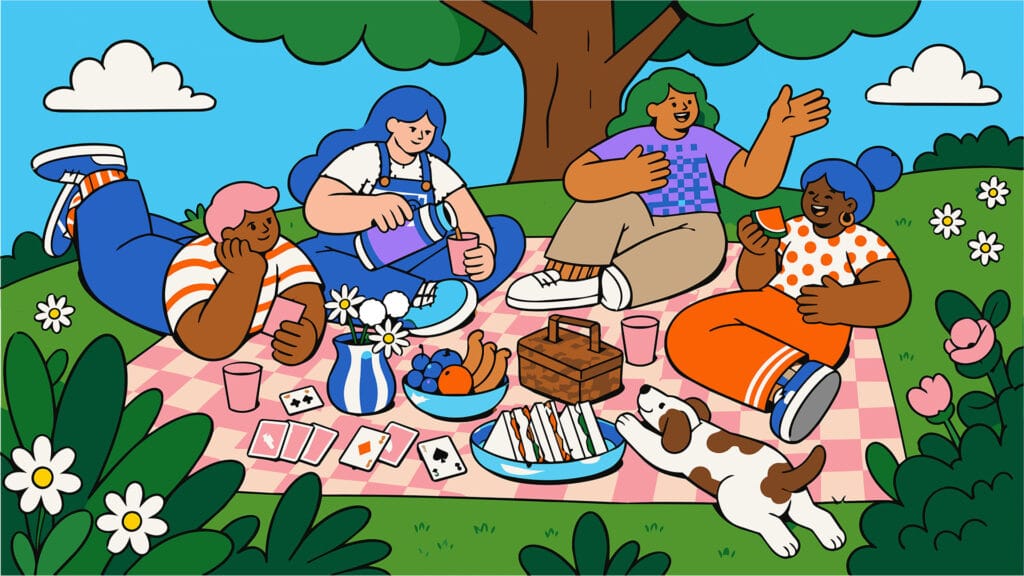
Games That Make You Laugh Until You Can’t Talk
Laughter is the shortcut. When you genuinely crack each other up, something in the room loosens, and it’s almost impossible to stay guarded while you’re both wheezing. These are the games built to get you there.
- Telestrations or Gartic Phone. Drawing plus telephone. Your terrible sketch of “man riding a horse” becomes something unspeakable four steps later. The gap between what you meant and what landed is the whole joke, and it’s reliably devastating.
- Psych! Everyone writes a fake answer to a real trivia question and tries to fool each other. Watching your partner confidently invent a completely wrong fact tells you more about their brain than a year of small talk.
- Exploding Kittens. A card game that’s basically a deck of cartoon chaos. Low skill, high cackle. Perfect for a night when you want fun without a learning curve.
- Charades, but only with inside references. Regular charades is fine. Charades where every prompt is a person you both know or a thing that happened on your last trip is where the real laughing lives.
- Two Truths and a Lie, funny edition. Same rules, but the truths have to be embarrassing. The bar to clear is “would make the other person snort.”
- Joking Hazard or a similar comic-building card game. You build a three-panel comic together and the punchline is a group effort. It reveals exactly how twisted your partner’s sense of humor really is, which is either a green flag or a very fun red one.
Games That Teach You Something New About Each Other
You’d think after enough time together there’d be nothing left to learn. There always is. These games are designed to surface the stuff that never comes up in the logistics of a shared life, the small preferences and old stories and quiet opinions that hide in plain sight.
- The Ranking Game. One of you ranks a list (best pizza toppings, most overrated movies, your friends by who’d survive an apocalypse) and the other tries to guess the order. The arguments about the ranking are where you actually learn how they see the world.
- Desert Island. Three of anything you’d take. Books, foods, people, songs. Simple, and it goes surprisingly deep depending on what you choose to bring and what you’d leave.
- 21 Questions or a good deck of conversation cards. A structured way to ask the things you’d feel weird asking cold. The structure is what gives you permission. If you want a place to start, our big list of questions for couples works as a homemade deck.
- Would You Rather, the thoughtful version. Not the gross-out kind. The kind that quietly reveals values. “Would you rather be forgotten or remembered wrong?” tells you something a normal Tuesday never would. We’ve got a whole set of would you rather questions for couples if you want them ready to go.
- The Story of Us. Take turns telling the story of a shared memory from your own point of view. You’ll be amazed how differently you each remember the night you met.
- Bonded. Our own app is built on exactly this mechanism: guided prompts that move you from small talk to genuine contact without either of you having to be the one who “gets deep” first. More on that at the end.
Games Where You’re on the Same Team
Most games put you against each other. Cooperative games put you against the game, which is a completely different feeling. Suddenly you’re reading each other, covering for each other, celebrating together. It’s low-key relationship practice disguised as a fun night in.
- Codenames Duet. The two-player version of the word-association classic. You give each other one-word clues to find hidden agents, and the whole game is a test of whether you can think the way your partner thinks. Weirdly intimate.
- Hanabi. A cooperative card game where you can see everyone’s cards except your own and have to give careful hints. Patience and trust, gamified.
- It Takes Two. If you have a console, this is the co-op video game to play. You literally cannot progress without cooperating, and the story is, fittingly, about a couple relearning how to work together.
- Overcooked. A chaotic kitchen game where you’ll either learn to communicate under pressure or discover exactly how you both handle stress. Usually both. Often loudly.
- Escape room kits or Escape Simulator. Puzzle-solving where two heads genuinely beat one. Buy a boxed escape-room-in-a-box or play the digital version and watch how you naturally divide the work.
- Keep Talking and Nobody Explodes. One of you sees a bomb, the other has the manual, and neither can see the other’s screen. You have to talk your way through it. It’s the trust exercise your therapist wishes they could prescribe.
- Ticket to Ride, in team mode. Usually competitive, but play as a single team against imagined rivals and it becomes a gentle exercise in shared planning.

Games With Just Enough Competition
A little friendly rivalry is good for you. It wakes people up, and it shows you a side of your partner that only comes out when there’s something small on the line. The trick is keeping it light. More on that below, because this is the category most likely to go sideways.
- Bananagrams. Fast, tile-based word building. Quick rounds, low setup, and a satisfying scramble that rewards a nimble brain over a competitive one.
- Jaipur. A two-player trading card game that’s the gold standard for date-night competition. Ten minutes to learn, endlessly replayable, and just deep enough to feel clever without feeling like homework.
- 7 Wonders Duel. A meatier two-player strategy game for couples who like to actually think. Multiple paths to victory means you’re rarely playing the same game twice.
- Mario Kart. The great equalizer. A blue shell has ended more win streaks and started more mock arguments than any board game in history.
- Backgammon or chess. Old for a reason. A standing set on the coffee table turns idle evenings into a slow-burn rivalry you can pick up any time.
- Ping-pong or a card game like Speed. Anything with a physical or fast-reflex element gets you both laughing and slightly out of breath, which is a better mood-setter than it sounds.
- Rummy or Gin. The classic two-hander. Simple enough for wine, deep enough to keep a running score across a whole relationship.
Games That Turn the Temperature Up
Some nights you’re not after teamwork or trivia. You’re after each other. These lean playful and a little flirtatious, the kind of games for couples that make a regular Tuesday feel like a date. Keep it in the spirit of fun and pay attention to where the other person actually wants it to go.
- Truth or Dare, couples edition. The old party game, just the two of you, is a surprisingly good way to flirt with structure. Our truth or dare for couples list runs from playful to bold so you can set the dial yourselves.
- Flirty dares. If you want the dares without the truths, a curated set does the job. Our flirty dares for date night are built for exactly this.
- Would You Rather, flirty version. Same easy format, warmer questions. A low-effort way to nudge the evening somewhere new.
- Strip anything, lightly. Strip poker gets the headlines, but any game works with the same house rule. The stakes do the flirting for you.
- Blindfold taste test. One of you brings a few small things from the kitchen, the other guesses blindfolded. It’s silly, it’s sensory, and it puts you close and paying attention, which is most of the point.
- Two Truths and a Lie, warmer edition. Steer the reveals toward attraction and memory. “The first time I thought I might love you was…” is a very good statement to have to guess at.
Games for When You’re Apart
Distance changes the logistics, not the goal. You can still play together across a hundred miles or a whole ocean, and a shared game is one of the better antidotes to the flat, “so how was your day” rhythm that long-distance can fall into.
- 20 Questions over text. One person thinks of something, the other has twenty yes-or-no questions to guess it. Slow-drip fun that fits into a workday without either of you having to be free at the same minute.
- Online multiplayer board games. Codenames, Ticket to Ride, and dozens of classics have online versions you can play over a video call. The call is half the point.
- Chess.com or Words With Friends. Asynchronous by design. Make a move whenever, and the ongoing game becomes a quiet thread of “I’m thinking about you” that doesn’t require a paragraph.
- A synced watch-and-guess. Stream the same show and text predictions about what happens next. Loser picks the next episode.
- Question apps you both open. A shared prompt app keeps the conversation from defaulting to logistics. This is a lot of why we built Bonded to work across distance too.
- Trivia over video call. Pull up any online quiz, share your screen, and keep score. Easy, and it gives a call a shape beyond the update-and-goodnight loop.

Games That Need Nothing But the Two of You
No board, no app, no shopping. These are the ones for a power outage, a long drive, a plane, or a night when you can’t be bothered to set anything up. Proof that the best games for couples often cost exactly nothing.
- 20 Questions. The whole game lives in your head. Endlessly portable, quietly revealing.
- Two Truths and a Lie. Needs zero equipment and always finds something you didn’t know.
- The Alphabet Game. Pick a category and take turns naming things through the alphabet. Harmless on the surface, cutthroat by the letter Q.
- Story, one sentence each. Build a ridiculous story by alternating single sentences. It goes off the rails fast, and where it goes says a lot about both of you.
- Would You Rather. No props, infinite supply, adjustable depth. The Swiss Army knife of no-setup games.
- “When did you know?” Not really a game, more a prompt with rules: take turns naming a specific moment you felt something. First laugh, first fight, first time it felt like home. It’s the one on this list most likely to end with someone getting a little misty.
A Few Things to Keep in Mind
Lose well. This is the whole ballgame. If winning a card game makes you insufferable and losing makes you sulk, no game on earth will bring you closer, because the game isn’t the problem anymore. The point of playing with someone you love is not to beat them. It’s to be in it together while one of you happens to win.
Don’t weaponize the competitive ones. Bananagrams should never end a relationship. If you notice a game consistently making one of you feel small, retire it. There are forty others on this list.
Put the phones away, unless the phone is the game. Half of what makes a game work is the undivided attention. A game you’re half-playing while checking notifications gives you none of the benefit and all of the passive-aggression.
And let the conversation outlive the game. The best sign a game did its job is that you kept talking long after you stopped playing, the cards abandoned mid-hand because something better came up. The game was never the point. It was the container. The conversation is the point.
One Last Thing
The reason games for couples work isn’t complicated, and it isn’t really about the games. It’s that connection is easier when you’re doing something than when you’re staring at it.
Give two people a shared task and a reason to pay attention to each other, and closeness tends to show up on its own, uninvited, in the gap between turns.
That’s the entire idea behind what we’re building.
Bonded is a game for couples in the truest sense: guided conversation, phone haptics, and real-world presence prompts designed to move you from small talk to genuine contact, without either of you having to be the brave one who “gets deep” first. It’s the running start, in an app.
But you don’t need us to start tonight.
Pick one game off this list. Play it badly. Laugh at how badly. See what you’re still talking about an hour later, long after somebody won.
You might also enjoy: