
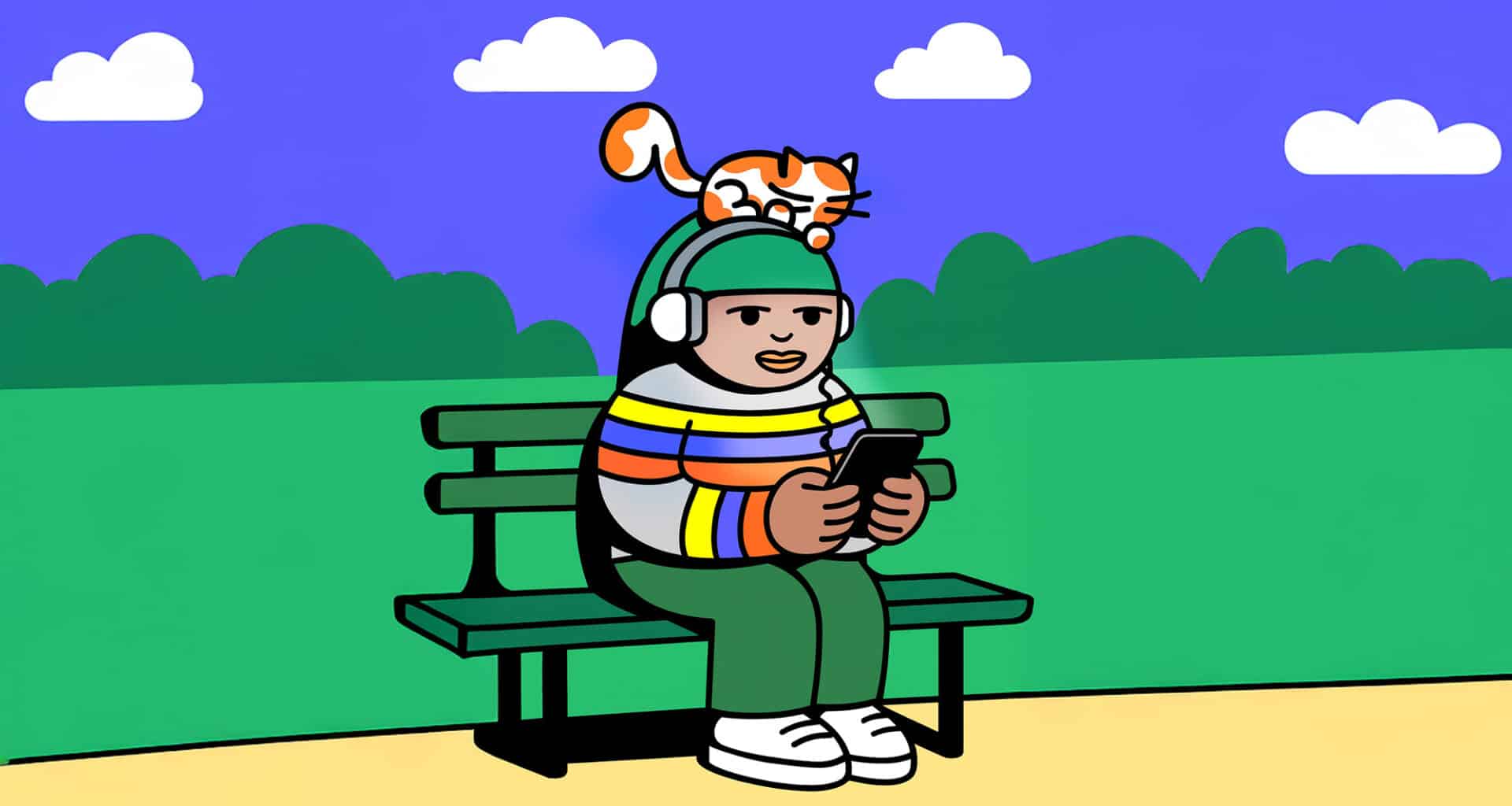
There is a specific half-second where you have decided to say something to her and your brain, sensing danger, quietly deletes every word you have ever known. You had a thought. It was a good thought. It is gone now. In its place is a low hum and the growing certainty that “hey” is about to come out of your mouth like it’s the first word humans ever invented.
Everybody who has wanted to talk to a girl knows that half-second.
The internet’s answer to it is a firehose of conversation starters with a girl that promise to “grab her attention” and “make you stand out from every other guy.”
Most of that advice is quietly making the problem worse, because it treats the opening line as a magic key and the girl as a lock.
That framing is exactly why you freeze. You’re not looking for something to say…
You’re auditioning, and you know it, and so does she.
Let’s take the pressure off the line, because the line was never the hard part.
Why most conversation-starter advice makes it harder
Open a few of the top guides and you’ll notice they all sound like coaching from a heist movie. Openers to “disarm her.” Lines to “spike her interest.” Rules to “impress her” so you don’t look like every other guy. It’s all framed as a tactic you run on a person to get a result out of her.
The problem isn’t that these lines don’t work. Some of them do. The problem is that they set up the entire interaction as a performance you have to nail, which loads the first sentence with the weight of the whole outcome.
No wonder you blank.
You’re not trying to say hi to a human being. You’re trying to pass a test she doesn’t know she’s giving.
Here’s the reframe that actually helps.
A conversation starter is not a key that unlocks her. It’s a door you push open to find out whether there’s someone on the other side you want to keep talking to.
That’s the whole job.
You’re not there to win her. You’re there to find out if there’s a real person behind the version of her you’ve built in your head, and whether the two of you click when you actually talk.
That’s a lower-stakes game, and it’s also the true one. It’s easier to walk up to a door than to pick a lock.
The one thing that matters more than your opener
Researchers Karen Huang, Michael Yeomans, and colleagues ran a study on what makes people like each other in conversation, and the finding, written up in Harvard Business Review, is almost annoyingly simple: people who ask more questions, and especially more follow-up questions, are liked more. Not people with cleverer opening lines.
People who stay curious after the other person answers.
Read that again, because it changes everything about how much your first sentence matters. The opener gets you in the room. The follow-up is what makes her want to stay in it.
Picture it. You ask what she’s reading. She says the title. A bad conversation ends there, both of you nodding, the silence closing back over like water. A good one keeps going: is it any good, would she recommend it, is she the kind of person who finishes books or abandons them at page forty.
Same opener.
Completely different outcome, decided entirely by what you did with her answer.
So if you take one thing from this whole article, take this: your opener can be almost anything, as long as you genuinely listen to what comes back and ask about it. The line is the ignition. The follow-up is the engine.
Which is a relief, honestly. It means you don’t need the perfect thing to say. You need one honest, answerable question and the willingness to actually care about the answer.
How to start a conversation with a girl in person
In person, the best openers are situational.
You’re both standing in the same reality, so use it.
The weather, the line you’re both waiting in, the band, the drink she ordered, the dog she’s petting. Situational openers work because they give her something easy to answer and they don’t announce that you’ve been rehearsing for six minutes.
A few that sound like a person, not a script:
- “Okay, I have to ask. That drink looks incredible and I’m about to order badly. What is it?”
- “You look like you have an opinion about this playlist. Am I wrong?”
- “I need a tiebreaker for an argument I’m having with myself. Is a hot dog a sandwich, yes or no?”
- “I’m going to regret it if I don’t just say hi, so, hi. I’m [your name].”
- “Genuine question: is this coffee good or have we all just agreed to pretend?”
Notice what none of those do.
None of them lead with how she looks. None of them are a compliment fishing for a thank-you.
Each one hands her a small, low-cost thing to react to, and each one leaves an obvious lane for a follow-up. That last part is the point. You’re not trying to land a great line. You’re trying to open a lane.
The honest one at the end deserves a note. “I’m going to regret not saying hi” works precisely because it drops the act. It admits, lightly, that this is a little nerve-racking, which is disarming in the real sense of the word: it lowers both your guards at once. Sincerity reads as confidence far more often than a polished line does.

Conversation starters for texting or a dating app
Over text, “hey” goes to die. Not because it’s offensive, but because it puts the entire burden of the conversation on her and gives her nothing to grab. If you’ve matched on an app, you have a gift most people ignore: her profile.
She literally handed you a list of things she wanted to talk about.
Use it. Reference something specific and ask something she can actually answer:
- “Your profile says you’ll argue about the best pizza in town. I’m ready. Make your case.”
- “I’m choosing to believe the photo of you on that mountain has a story. Does it?”
- “What’s something you’re into that you could talk about for an hour without checking the time?”
- “Torn between saying something clever and just admitting your profile made me laugh and I got a little nervous. Going with option two.”
- “You listed three hobbies and I need to know which one is a lie you’re telling to seem interesting.”
The through-line: specific beats generic every time. “How’s your weekend?” could be sent to two hundred people. “How did the half-marathon go, or did you talk yourself out of it like a reasonable person?” could only be sent to her.
Specificity is how you prove you actually read her profile instead of swiping on autopilot, and it’s the single easiest way to not be the fortieth “hey” in her inbox.
One more thing about text, because it’s where good intentions go sideways. Match her energy and her pace. If she sends two sentences, don’t send eight. If she takes a few hours to reply, don’t send the “?” text twenty minutes later. Texting a girl you like is not an interrogation and it’s not a hostage negotiation. It’s a slow game of catch. Throw, wait, catch, throw.
Starters for a girl you already sort of know
Sometimes the girl isn’t a stranger.
She’s the coworker two desks over, the one in your friend group you’ve said “hey” to at eleven parties, the person from class you always end up next to.
This is a different problem.
The ice isn’t unbroken so much as permanently thin, and you both keep skating over it.
The move here is to name it, gently, and go one degree deeper than the usual nod:
- “I feel like we’ve said hi about forty times and never actually talked. Fixing that. How’s your week actually going, not the polite version?”
- “Random, but you mentioned you were learning to surf a while back. Did that stick, or is the board in a closet now?”
- “I’ve decided we’re upgrading from hallway small talk. What’s actually going on with you lately?”
What makes these land is memory. When you reference the surfing thing she mentioned three weeks ago, you’re telling her something no line can fake: you were paying attention.
Being remembered is a small, specific form of being seen, and it does more work than any opener because it can’t be performed. You either listened, or you didn’t.

Openers that show you were actually paying attention
This is worth its own section because it’s the highest-leverage move you have and almost nobody uses it.
Most people treat a conversation like a fresh start every time. The people who are magnetic to talk to treat it like a continuing story.
- “You said last time you were dreading that presentation. How’d it go?”
- “Did you ever finish the show you said you were three episodes behind on, or did you get spoiled?”
- “You called this place your spot. So I have to know: usual order?”
- “Last we talked you were deciding between two apartments. Which one won?”
These aren’t clever.
That’s the point.
They’re proof of attention, and attention is the rarest thing you can offer someone. In a world where most people are half-listening while they figure out what to say next, being genuinely tracked feels almost startling.
It’s the difference between a conversation starter and a conversation continuer, and the continuer wins every time.
Playful ones, for when you want it a little lighter
Not every conversation needs to be earnest. Sometimes the best way in is to be a bit ridiculous, because play lowers the stakes and gives you both permission to not be so careful. Playful openers also do something sneaky and useful: they reveal whether she’s fun to banter with, which is genuinely important information.
- “Important question that will determine everything: pineapple on pizza, defend or condemn.”
- “Would you rather fight one horse-sized duck or a hundred duck-sized horses? Take your time, this matters.”
- “On a scale of ‘mild inconvenience’ to ‘this is a personal attack,’ how do you feel about people who don’t return their shopping carts?”
- “Give me your most controversial food opinion. I promise to judge you fairly, which is to say, harshly.”
- “You get to be immediately, world-class good at one useless skill. What are you picking?”
The trick with playful is to actually play. If she volleys back a good answer, don’t drop it and move to your next scripted line. Riff on it.
The best flirty conversations aren’t a list of good questions.
They’re two people building a tiny bit and refusing to let it die.
Ones that go a step deeper, when it’s flowing
Once you’re actually talking and it’s easy, you can afford a question with a little more weight to it. Not heavy. Just real.
The best of these feel a touch daring to ask, and that faint sense of risk is not a bug. A question with zero risk usually creates zero intimacy.
A little friction is how you signal you want to know the actual person, not the small-talk version.
- “What’s something you changed your mind about in the last couple of years?”
- “What are you weirdly, specifically good at that never comes up?”
- “What’s something you’re into now that past-you would be baffled by?”
- “What’s the best thing that happened to you this year that had nothing to do with work?”
- “What’s a small thing that instantly makes your whole day better?”
These earn their place only after the warm-up. Lead with “what’s your greatest fear” and you’re the guy who confused a bus stop for a therapy session.
The whole art is sequence: light first, then real, then let it breathe.
If you want a deeper well to draw from once you’re past the opener, our lists of questions to ask a girl and questions to ask someone you like are built exactly for the “it’s going well, where do we go now” moment.
How to tell if it’s actually landing
Starting the conversation is half the skill.
The other half is reading whether she wants to be in it, because a good opener met with a closed door is your cue to change something or bow out gracefully, and pushing past that signal is how a nice guy becomes a story she tells her friends.
The tell is reciprocity.
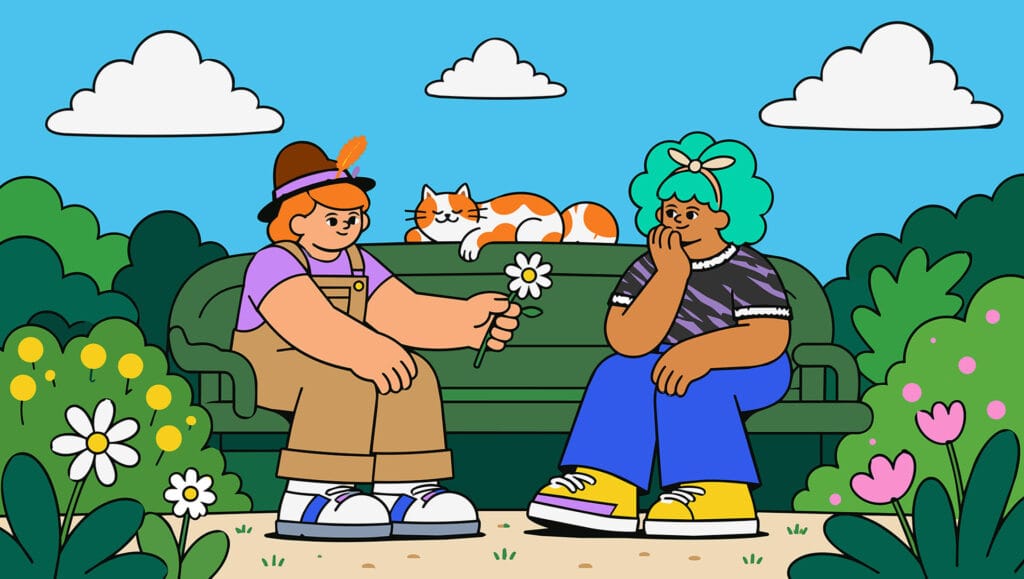
When a conversation is working, it flows in both directions. She answers, then asks you something back. She adds detail you didn’t ask for. She matches your energy, or raises it.
Those are open doors, and you should walk through them by staying curious.
The closed door is quieter but just as clear.
One-word answers. No questions coming back. Body angled away, phone reappearing, eyes scanning the room. If you’re getting that, it’s not a puzzle to solve with a better line. It’s a person telling you, politely, that the timing or the interest isn’t there.
Reading that accurately and giving her an easy out (“anyway, I’ll let you get back to it, was good to meet you”) is the most attractive thing in this entire article, because it proves you see her as a person whose “no” you respect, not an obstacle to route around.
Interestingly, most people are worse at reading the open door than the closed one.
Research on what psychologists call the “liking gap,” covered by the Greater Good Science Center, found that after conversations with someone new, people consistently underestimate how much the other person enjoyed talking to them.
Translation: she probably likes the conversation more than your anxiety is telling you she does. The door is more often open than you think.

A few things to keep in mind
Don’t lead with her looks. “You’re gorgeous” isn’t a conversation starter, it’s a conversation ender, because it hands her nothing to say back except a thank-you and puts the whole thing on a footing you can’t build on. Compliment something she chose over something she was born with. Her taste, her laugh, the ridiculous keychain on her bag. Choices are a door. Genetics are a dead end.
Ditch the idea of the perfect line. There isn’t one, and hunting for it is what keeps you standing there running out of time. A slightly awkward but genuine “hi, I wanted to talk to you and I have no smooth way to do it” beats a flawless line delivered by someone clearly performing.
She can feel the difference between a person and a bit.
Here’s the truth underneath all of this. Most people don’t actually need better conversation skills. They need permission.
Permission to walk up.
Permission to ask the thing they’re curious about instead of the safe thing.
Permission to be a little awkward and find out it’s survivable.
The skill is real, but it’s secondary.
The blocker is almost never technique.
It’s nerve.
And nerve gets easier the more you reframe the whole thing away from “impress her” and toward “find out if we click.” One is a performance you can fail.
The other is just curiosity, and curiosity is something you already have. You wanted to talk to her for a reason. Lead with that reason, honestly, and you’re most of the way there.
For a fuller playbook on turning a first exchange into actually knowing someone, we wrote a whole guide on how to get to know someone when you genuinely want to.
One last thing
The reason “conversation starters with a girl” gets searched millions of times isn’t that people are bad at talking. It’s that the moment before you speak feels enormous, and every guide out there makes it bigger by promising the one line that can’t fail. There is no such line. There’s just you, a little nervous, genuinely curious about a person, deciding to open a door.
Do that, listen to what comes back, and ask about it. That’s the whole thing. The nerves don’t fully go away, but they shrink every time you find out that the conversation was more survivable, and more fun, than the version your anxiety wrote in advance.
At Bonded, this is the entire premise behind what we build: connection isn’t a skill only naturals get to have, it’s a set of small, learnable moves, plus the permission to make them. If you want that nudge in your pocket, the Bonded app hands you the next good question when your mind goes blank, so the door stays easy to open. Because the hard part was never the words. It was deciding to say them.
You might also enjoy: