
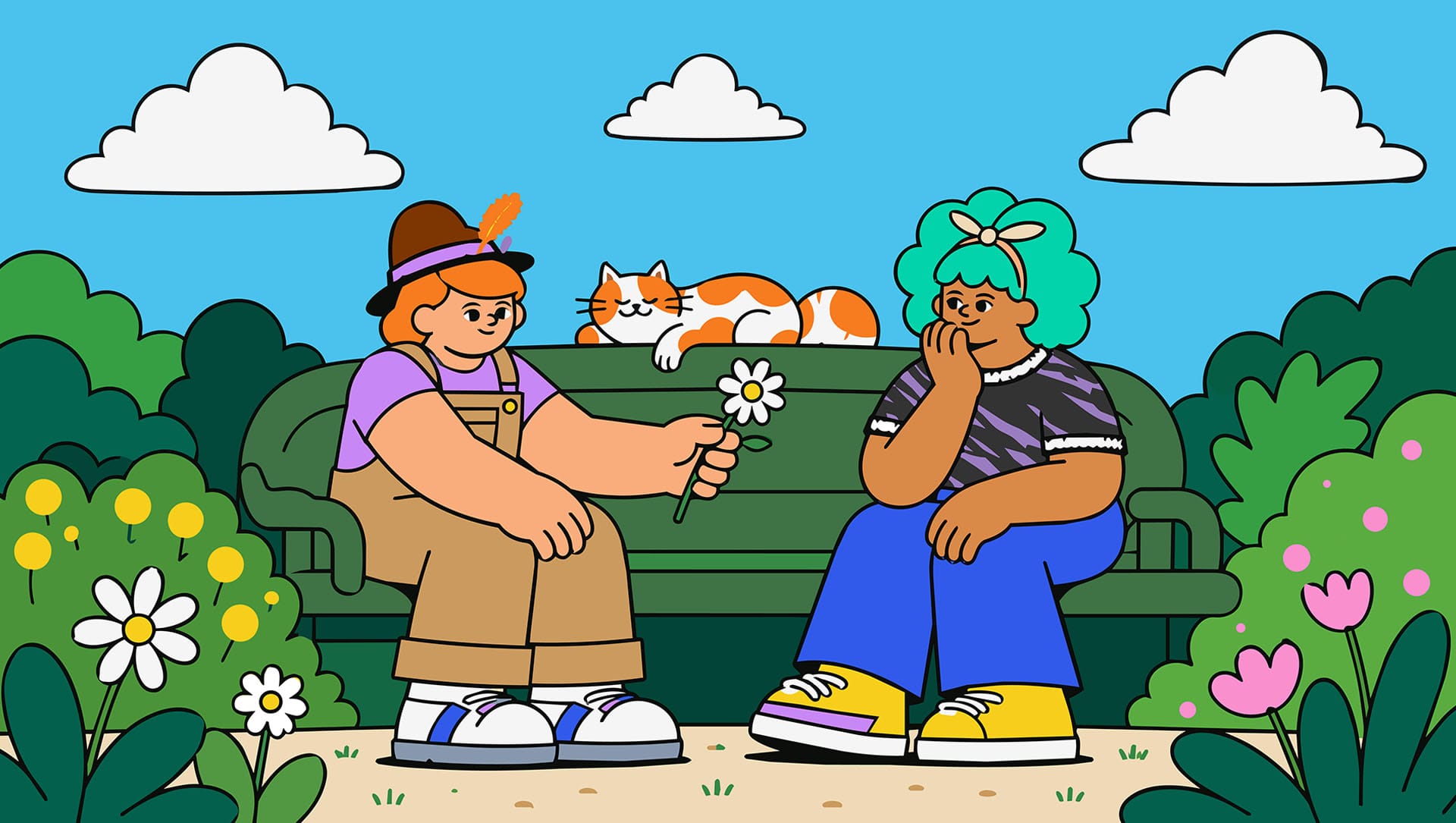
You’ve both just sat down. The drinks are ordered, the small talk about parking is officially over, and there’s this half-second where you can feel both of you reaching for the exact same tired opener at the exact same time.
That half-second is where most first dates quietly decide to be forgettable.
Here’s the part nobody tells you: the problem is almost never that you ran out of things to say. It’s that you were both waiting for permission to say anything that actually mattered. So if you came here looking for what to talk about on a first date, I’ll give you the topics. But the topics are the easy part, and they’re not really the thing standing between you and a good night.
Why “What Do I Talk About” Is Slightly the Wrong Question
If you searched this hoping for a magic list of subjects that guarantee chemistry, I have mildly annoying news. The topic matters far less than what the two of you do with it.
You could talk about breakfast cereal and have the best date of your year, if you’re both genuinely curious and genuinely honest. You could talk about your deepest values and bore each other into an early night, if you’re just taking turns reciting a prepared speech.
The good news buried in there: you don’t need to be more interesting. You need to be more interested.
And there’s real research behind that, not just a nice-sounding line. Across a series of studies out of Harvard, people who asked more follow-up questions were consistently rated as more likable by the person sitting across from them. Not the wittiest people at the table. The curious ones. Which is wonderful, because “be curious” is a much more doable instruction than “be effortlessly fascinating for two hours.”

The One Rule That Actually Matters
Trade. Don’t interview.
A first date goes wrong the second it turns into a press conference, one person firing questions while the other answers like they’re clearing customs. It also goes wrong in the opposite direction, when someone treats the table as a stage and forgets there’s a second chair with a person in it.
The rhythm you actually want is a trade. They share something, you meet it with something real of your own, then you hand the thread back. Ask, answer, offer, repeat. It sounds mechanical written down, but in practice it’s the most natural thing in the world, and it’s the quiet engine underneath every conversation that ever made you lose track of the time.
Openers That Lower the Stakes
Start light. The beginning of a date isn’t the place for your best material; it’s the place to help both of you exhale. These are warm, easy, and they give the other person something generous to grab onto.
- “What’s been the best part of your day so far?” Present tense, no pressure, and it quietly tells you whether they lead with the good stuff or the complaints.
- “What made you pick this place?” Let them play host for a second. People relax the instant they get to recommend something they love.
- “What have you been into lately? A show, a hobby, a total rabbit hole.” The word “lately” does the work here, inviting their current obsession instead of their résumé.
- “What’s something you’re weirdly good at?” Low stakes, high charm, and almost everyone has an answer they’ve been secretly waiting to give.
- “Are you more of a plans person or a wing-it person?” A tiny window into how they move through the world, disguised as banter.
- “What’s the last thing that genuinely made you laugh?” You learn their sense of humor and hand them a good memory in one move.
- “Coffee snob, tea person, or neither and you’re just here for the company?” Silly on purpose. Silly is a great way to start.
None of these are clever. That’s the point. Openers aren’t supposed to impress anyone; they’re supposed to make the next twenty minutes easier.
Topics That Show You How Someone Actually Thinks
Once the ice has genuinely melted, this is the good middle of a date. You’re not digging for secrets yet. You’re just steering toward the topics that let a real person show up instead of their dating-profile summary.
There’s a lovely finding here worth knowing. Research summarized in Psychology Today points to a slightly humbling truth about first-date chemistry: people tend to feel the most connected when they get to talk about themselves and feel understood doing it. So the “best topic” is often just whatever lets your date light up and tell you something true, while you actually listen.
- What they do, and whether they actually like it. The way someone talks about their work tells you far more than the job title ever will.
- How they’d spend a day with zero obligations. This is a person’s real values wearing casual clothes.
- What they were like as a kid. The line between who someone was at nine and who they are now is usually shorter than they think, and fun to trace together.
- A strong opinion they hold about something low-stakes. Best pizza topping. Worst airport. Whether cereal counts as soup. You learn how they argue when nothing’s at risk.
- Something they’ve changed their mind about. It quietly reveals whether they’re someone who grows, or someone who defends.
- Who they call when something good happens. The shape of a person’s closest relationships tells you a lot about how they love.
Topics That Make People Light Up
Some subjects just have more oxygen in them. They pull warmth and stories and the occasional surprised laugh out of people, and shared laughter, as it turns out, is one of the more honest signals that a date is going somewhere. Lean here when you want the energy to lift.
- Travel. The trip they’d repeat tomorrow, or the one still sitting on the list. Travel talk tends to summon dreams and good memories, which is a nice thing to have floating over a table.
- Food. The meal worth crossing town for. The thing they cook when nobody’s watching. Everyone has strong, joyful, slightly unhinged food opinions, and they’re a gift.
- The obsession. That one subject they could talk about for a straight hour if you let them. So let them. Watching a person light up about medieval history or vinyl records or their fantasy football strategy is more attractive than they will ever believe.
- A small, specific joy. Their comfort movie. Their Sunday ritual. The walk they take when their head is full. The little stuff is where people are most themselves.
The Move That Matters More Than Any Topic
Here’s the one skill worth more than any list on this page: when something interesting flickers, don’t move on. Go toward it.
Most people treat a conversation like a checklist, hopping from topic to topic, afraid of dead air. The good ones do the opposite. They hear one intriguing detail and they stay. “Wait, what was that like?” “What do you mean by that?” “Why that one?” Three of the least impressive-sounding questions in the language, and three of the most powerful things you can say on a date.
The best first dates almost never cover the most ground. They go deep on a few things and let the rest go. Fewer topics, more genuinely explored, beats a grand tour of your whole personality every single time.
How to Tell If a Topic Is Actually Landing
Half of knowing what to talk about is knowing when to keep going and when to change lanes. The good news is that people broadcast this constantly, if you’re watching instead of rehearsing your next line.
A topic is working when they add detail you didn’t ask for. You asked about their job and they’ve drifted into the coworker who microwaves fish, or the reason they almost quit last spring. That drift is the sound of someone relaxing. Follow it. The tangent is usually more alive than the original question.
A topic is dying when the answers get shorter, the eyes go a little flat, or they hand you the polite version and stop. “Yeah, it’s good.” “It was fine.” That’s not rejection, it’s just a road with nothing down it. Turn the wheel. Reach for something with more warmth in it, or bounce the conversation somewhere lighter and let the pressure off.
Watch for the lean, too. People physically move toward the parts of a conversation they like, and away from the parts they don’t. A little forward lean, a laugh that lasts a beat longer than the joke earned, a “wait, tell me more” they didn’t have to offer. Those are the moments the date is quietly choosing itself. When you feel one, stay a while. You found the good stuff, and there’s no rule that says you have to leave it to cover the rest of your prepared material.
The one signal to distrust is your own inner panic. It runs about ten times louder than reality and it will tell you a fine conversation is a disaster. Turn it down and read the actual person in front of you instead.
How to Go Deeper Without Making It Weird
At some point, if it’s going well, you’ll feel the conversation ask to go somewhere realer. Don’t sprint there, and don’t avoid it either. Just make sure the ice is fully broken first, then follow the warmth.
The best questions on a first date feel a little bit dangerous to ask. Not inappropriate, not intense, just carrying a whisper of “am I allowed to ask this?” That tiny friction is exactly what separates a real moment from a nice one. A question with zero social risk tends to create zero real closeness too.
- “What are you the most yourself around?”
- “What’s something you’re figuring out right now?”
- “What’s changed most about what you want, compared to a few years ago?”
Questions like these work because of how intimacy is actually built, not because they sound deep. Decades of research on closeness, including Arthur Aron’s well-known 36 questions study, point to the same quiet mechanism: two people taking turns revealing slightly more than feels comfortable, and each one responding in a way that says “I heard that, and I’m still here.” That’s it. That’s the whole trick. You just do a gentle, first-date-sized version of it.
Topics to Actually Skip on a First Date (and Why)
Every article on the internet will tell you to avoid politics, religion, exes, and money. Fine. But rules you don’t understand are easy to break by accident, so here’s the reasoning, because the reasoning is what actually keeps you out of trouble.
- Your ex, in any version. Not because it’s forbidden, but because it drags a third person to a table you set for two. Save the relationship post-mortem for your friends.
- Exact salary, rent, or what they paid for things. Financial curiosity reads as an audit, and it’s simply too early. You can learn whether someone is ambitious without learning their credit score.
- “So, what are you looking for?” in the first twenty minutes. A perfectly good question for date three. On date one it turns a pleasant evening into a job interview for a role neither of you has defined yet.
- The full trauma download. Vulnerability is not the same as handing someone your entire emotional and medical history before the appetizers arrive. Real closeness is specific and paced; oversharing is just anxiety with an audience. There’s a genuine difference between the two, and it’s worth understanding why vulnerability builds closeness faster than small talk when it’s done with a little care.
- Hot-button politics as a compatibility test. Your values will come through in a hundred softer ways over the night. You don’t need to run a debate to find out if someone’s kind.
What to Do When the Conversation Stalls
It will happen. A topic runs out, someone takes a sip of their drink, and suddenly there’s a pause that feels, to you, roughly the length of a geological era. Breathe. A three-second silence feels enormous from the inside and like absolutely nothing from across the table.
When you do want to restart the current, you have easy options:
- Comment on something in the room. The weird art, the song playing, the couple clearly on a worse date than yours. Shared observation is the lowest-effort bonding there is.
- Loop back. “You mentioned earlier you grew up in Portland, what was that like?” Returning to something they said signals you were actually listening, which is its own small gift.
- Call it out with a wink. “Okay, real question.” People visibly perk up when you announce a real question. It’s permission for both of you to stop skating on the surface.
The pause isn’t the failure. Treating it like an emergency is the only thing that can turn it into one.
A Few Things to Keep in Mind
You do not have to be the most entertaining person your date has ever met. You have to be present, warm, and honestly curious. That’s a bar you can clear on a bad night.
Answer the questions you’re asked with something true instead of something safe. “Fine” and “good” and “the usual” are conversational dead ends, and you’re better than the usual. When they ask about your week, give them a real detail. The specific is always more interesting than the polished.
Watch for whether you’re both talking, not just whether they seem into it. A date where one person does ninety percent of the sharing isn’t a connection; it’s a monologue with a witness. The trade is the whole point.
And if it isn’t clicking, that’s allowed. Not every kind, interesting person is your person, and one flat conversation isn’t a referendum on you. Sometimes two perfectly nice people just don’t have the current. You get to notice that without it being anyone’s fault.
One Last Thing
The best first dates aren’t the ones where you said the perfect thing. They’re the ones where, somewhere around the second drink, you both forgot you were performing and just started talking. The topics stopped mattering because the two of you were actually there.
That’s the whole secret, and it’s almost disappointingly simple. Be curious. Trade honestly. Follow the warmth when it shows up, and don’t panic at the silences. Everything on this list is just scaffolding to get you to the moment the scaffolding falls away.
If it helps to walk in with a little something in your back pocket, that’s more than fair. Nerves are real, and a few good prompts can be the difference between a stiff start and an easy one.
You might also enjoy: